
Marketing teams are expected to do more than ever. Produce content, analyse performance, find new customers, improve search visibility, manage campaigns and somehow stay on top of everything happening across the business.
AI promises to make this easier. But using ChatGPT to write the occasional LinkedIn post is very different from building a system that genuinely improves how a marketing team operates.
I’ve become increasingly interested in that distinction through my work in B2B growth, marketing automation and AI-assisted prospect research.
The question I keep coming back to isn’t how many marketing tasks AI can perform. It’s how we can connect those capabilities into a system that actually helps a business grow.
That’s where specialised AI agents come in.
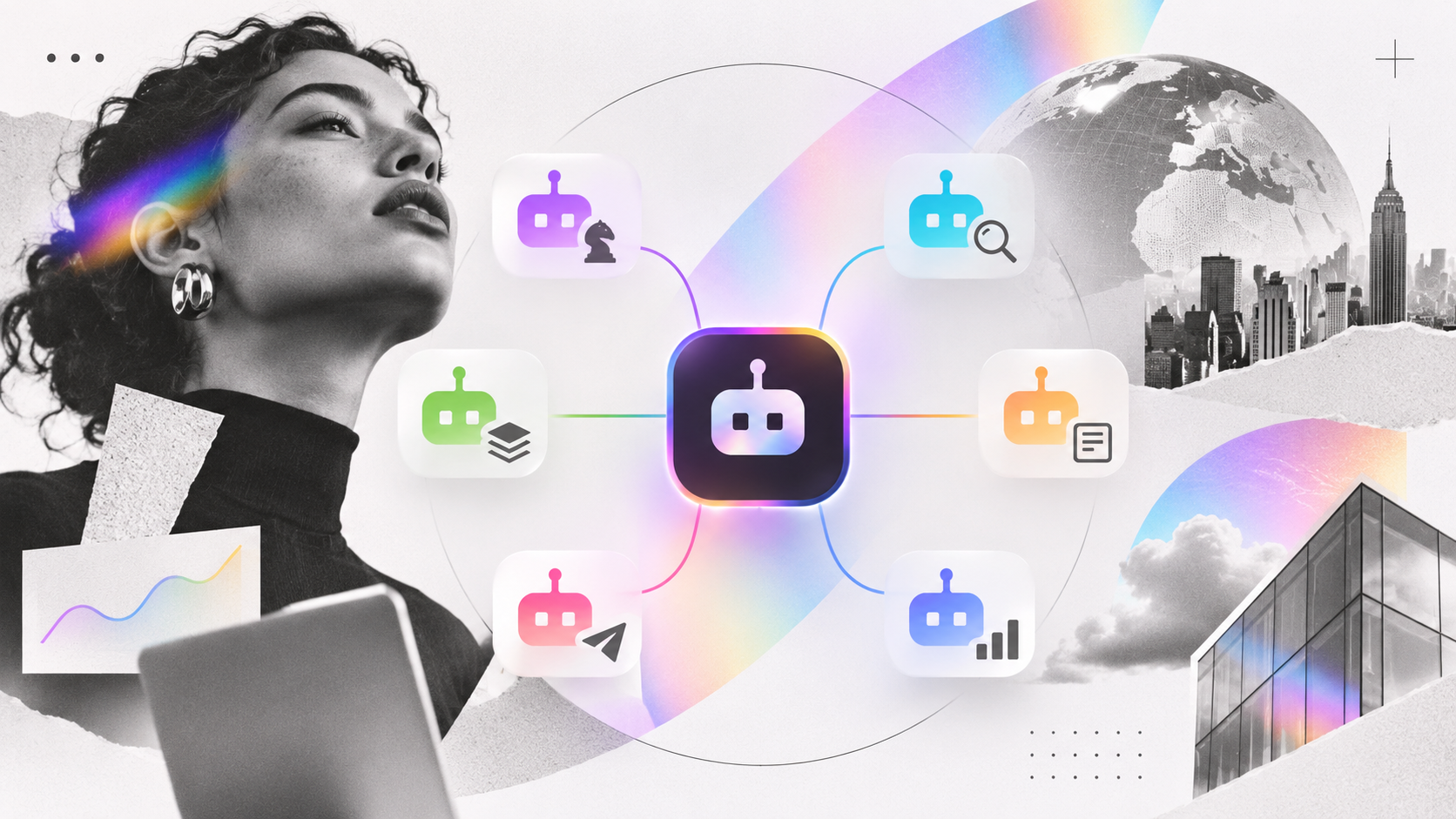
A practical AI marketing team is a connected system of specialised AI agents and workflows that support functions such as market research, SEO, lead generation, content production and performance analysis. Each agent has a defined role, access to appropriate information and clear limits. Human marketers remain responsible for strategy, approvals and results.
You don’t need 50 agents to get started. In fact, you probably shouldn’t build 50 agents at all.
You need to identify the work worth improving, design a reliable process and gradually introduce automation where it makes sense.
Why AI marketing teams are becoming relevant in 2026
AI adoption is accelerating, but many businesses are still figuring out how to turn experimentation into meaningful operational improvements.
According to the UK Department for Science, Innovation and Technology’s 2026 AI Adoption Survey, 32% of UK businesses were using at least one AI technology in 2026, compared with 16% in 2025.
The same research found that skills, accuracy and the ability to demonstrate a business case remain significant barriers to adoption.
That second point matters.
There’s a difference between having access to powerful AI tools and knowing how to use them effectively.
A marketing team might have ChatGPT for content, an SEO platform for keyword research, a CRM for customer information and an automation tool connecting a few applications.
Yet the work may still depend on someone manually moving information between those systems.
The opportunity isn’t simply to introduce another tool. It’s to make existing tools work together more intelligently.
What exactly is an AI marketing agent?
The terms AI assistant, automation and AI agent are often used interchangeably. They’re related, but they describe different levels of capability.
Traditional automation follows a predefined sequence of rules. For example, when somebody submits a form, their details are added to a CRM.
An AI assistant helps perform a task when prompted. It might summarise a research report, suggest campaign ideas or draft an email.
An AI agent can work towards a defined goal by selecting tools, interpreting information and deciding which permitted steps to take next.
For example, a research agent could receive a list of target companies, inspect approved information sources, identify relevant signals and produce a structured report for a salesperson to review.
It may need to search several sources or revise its approach before completing the task.
Anthropic explains the distinction between fixed workflows and autonomous agents in its guide to building effective AI agents.
The important takeaway is that more autonomy isn’t automatically better.
For predictable tasks, a straightforward workflow will often be cheaper, easier to maintain and more reliable than an autonomous agent.
The six specialised agents I’d build first
A marketing team doesn’t need a digital version of every employee.
It needs capabilities that solve recurring problems.
If I were designing a practical AI marketing system for a growing B2B business, these are the six areas I’d prioritise.
1. Market intelligence agent
Purpose: Understand the market and surface useful opportunities.
This agent could monitor selected competitors, analyse public announcements, review industry developments and flag changes worth investigating.
Rather than sending marketers endless articles, its output should be a concise, evidence-backed brief containing:
- What has changed
- Why it matters to the business
- Which sources support the finding
- What the marketing team might do next
A particularly useful application is identifying commercial signals before they become obvious to competitors.
For example, a company announcing a new funding round might be preparing to hire, enter another market or invest in its operations.
That’s a reason to investigate, not proof that the company needs a particular service.
A good agent should understand the difference.
2. SEO and AI search agent
Purpose: Identify opportunities to improve search visibility and make content more useful.
An SEO agent can combine search performance data, website information and approved research sources to identify:
- Pages losing organic visibility
- Relevant content gaps
- Search queries that existing articles don’t answer properly
- Opportunities to improve internal linking
- Pages that need technical or editorial attention
It can also support content designed to answer the questions people ask through search engines and AI-powered discovery tools.
However, this is where human expertise becomes especially important.
Google’s official guidance on optimising for generative AI search emphasises original, helpful and reliable content. It does not recommend a separate collection of GEO tricks or special AI schema as a shortcut.
An agent can identify a gap. It cannot automatically supply genuine experience or original insight.
The objective shouldn’t be to publish more articles. It should be to identify where your business has something useful to say.
3. Lead research and qualification agent
Purpose: Help identify companies that may be commercially relevant.
This is one of the areas where I’ve seen the clearest potential from combining AI with structured data and go-to-market workflows.
In my B2B marketing work, I’ve used Clay and signal-based prospecting to research companies against specific commercial criteria.
For example, when targeting innovation-led businesses, relevant signals could include sector activity, fundraising announcements, company characteristics and potential fit with a particular service.
An AI-supported qualification workflow can help turn those inputs into a structured prospect brief.
That might include the company’s sector, relevant recent developments, the reason it could be a suitable prospect and any information that needs checking.
But the system shouldn’t treat inferred demand as established fact.
And it should not assume that finding somebody’s contact details gives the business unrestricted permission to contact them.
The UK’s Information Commissioner’s Office guidance on B2B marketing explains how PECR and UK GDPR apply to business contacts.
A research agent can support qualification. The organisation still needs to decide how it uses that information lawfully.
4. Content production agent
Purpose: Turn approved ideas into useful, consistent marketing material.
A content agent can help develop briefs, drafts and variations for different channels.
For example, one approved research report could inform a blog article, several social posts, a newsletter and a campaign landing page.
The key is providing the agent with enough context.
It should understand the audience, brand voice, source material, intended purpose and what it must not claim.
I would also separate content creation from editorial review.
One agent can draft. A second process can check whether the text accurately reflects the sources, follows brand guidelines and includes unsupported statements.
A human editor should make the final publication decision.
Otherwise, automation can quickly turn one weak idea into ten pieces of weak content.
5. Lifecycle marketing agent
Purpose: Improve how businesses nurture and retain customers.
A lifecycle agent could support email segmentation, campaign planning and personalised content suggestions.
Imagine a prospect who downloads a technical guide and subsequently visits a relevant service page.
The system might suggest an appropriate follow-up sequence based on approved segmentation rules and the information the organisation is permitted to use.
Or it could identify subscribers who are no longer engaging with communications and recommend an adjustment to the email programme.
The objective is relevance rather than volume.
Any automated communications must respect marketing permissions, opt-outs and applicable data protection requirements.
6. Analytics and quality control agent
Purpose: Help marketers understand what’s working and identify problems earlier.
Marketing data is often spread across advertising platforms, analytics tools, CRMs and spreadsheets.
An analytics agent can bring together permitted data, flag unexpected changes and prepare reports around agreed metrics.
For example, if a campaign generates more leads but fewer qualified conversations, the system could flag the mismatch and identify areas worth investigating.
It shouldn’t automatically conclude why performance changed.
That requires context, clean attribution and often a human analyst.
I would also give quality control a defined role across the entire system, checking outputs for missing evidence, inconsistencies and actions requiring approval.
How the agents work together
The most interesting part isn’t what each agent can do independently.
It’s what happens when they become part of one connected process.
I think of this as a small marketing operating system.
At the centre sits an orchestrator, which receives a task and coordinates the relevant specialist agents.
An orchestrator doesn’t need unrestricted access to every marketing platform. Its job is to route work, maintain context and bring results together.
A simplified system might look like this:
Business objective → Orchestrator → Specialist agents → Quality checks → Human approval → Marketing systems → Performance feedback
For example, imagine a business wants to generate more conversations with growing biotechnology companies.
The process could work as follows:
- The research workflow identifies businesses matching a defined sector and company profile
- The intelligence agent examines relevant public signals, such as verified fundraising announcements
- The qualification agent prepares a structured explanation of why each business may be relevant
- The content agent drafts appropriate, evidence-based messaging
- A human marketer reviews the research, commercial fit and proposed outreach
- The approved campaign is managed through the appropriate CRM and outreach systems
- The analytics agent reports on qualified conversations, pipeline progression and other agreed outcomes
This is an illustrative architecture informed by my experience with signal-led B2B marketing. It is not a claim that all these steps have already been automated or that the workflow guarantees a commercial outcome.
The real benefit comes from reducing unnecessary handoffs while retaining control over decisions that matter.
My framework: Give every agent one job, one output and one boundary
When building an AI marketing workflow, I find it useful to start with three questions.
What is this agent responsible for?
The description should be specific enough that another person can tell whether the task has been completed.
«Improve marketing» is too broad.
«Identify five evidence-backed content opportunities from approved Search Console data» is much more useful.
What should the agent produce?
Define the output before building the workflow.
It might be a research brief, a structured CRM record, a content draft, a prioritised list of recommendations or an exception report.
The output should be easy for a person or another system to inspect.
What must the agent never do without approval?
This is the part many demonstrations leave out.
An agent that can read campaign data has a different risk profile from one that can change advertising budgets, delete CRM records or send messages externally.
I would introduce permissions in three stages:
- Observe: Read approved information and identify opportunities
- Prepare: Create drafts, recommendations or proposed changes
- Act: Make permitted changes only after the required checks and approvals
The more consequential the action, the stronger the controls should be.
This makes systems easier to test, govern and expand.
How to build your first AI marketing workflow
You don’t need to begin with a complex multi-agent architecture.
I’d approach the first implementation in five steps.
Step 1: Find the repetitive work that matters
List the recurring tasks consuming your marketing team’s time.
Look for activities that involve gathering information, moving data, checking documents, preparing reports or repeating clearly defined steps.
Then ask whether improving the task would meaningfully affect productivity or commercial outcomes.
A task being repetitive doesn’t necessarily mean it should be automated.
Step 2: Build the simplest reliable version
Before introducing several agents, test whether the task can be solved with a basic integration, a structured prompt or a fixed workflow.
Start with one well-defined task, a limited dataset and clear success criteria.
For example, ask the system to prepare a weekly search performance brief from approved reporting data.
That is a much better starting point than giving an autonomous system control over your entire SEO strategy.
Step 3: Connect the right information
An agent is only as useful as the information and tools it can access.
For a marketing workflow, that might include approved documents, analytics exports, selected research sources and carefully scoped CRM information.
Document which system contains the authoritative data.
A CRM record, an AI-generated summary and an official company announcement are not interchangeable sources.
Where information is missing, the agent should report that limitation rather than inventing an answer.
Step 4: Test the system against real tasks
Before deploying a workflow, test it against a representative set of examples.
I would start with around 20 cases covering straightforward tasks, ambiguous inputs, missing data and likely failure scenarios. That’s a practical pilot recommendation, not an industry standard.
For each case, evaluate whether the system:
- Completed the correct task
- Used reliable information
- Followed its permissions
- Produced a usable result
- Escalated uncertainty appropriately
Compare performance with the existing human-led process.
If the workflow creates more checking and corrections than it saves, it isn’t ready.
Step 5: Measure value before adding complexity
Once the first workflow is reliable, measure what changed.
The relevant metrics depend on the activity, but I would look at time saved, output acceptance, error rates, cost and business outcomes.
For lead generation, that might mean qualified conversations rather than the number of records processed.
For content, it might mean useful articles published, editorial rework and resulting engagement rather than drafts generated.
For reporting, it might mean fewer manual hours alongside more accurate and timely insights.
Only then would I consider introducing additional specialist agents.
What about security, privacy and regulation?
This is one area where businesses need to be particularly careful.
AI agents can introduce additional risks because they may access information, interact with third-party systems and take actions across multiple tools.
In May 2026, the UK’s National Cyber Security Centre published guidance on adopting agentic AI carefully.
Its advice emphasises starting with tightly controlled, lower-risk use cases and applying established cybersecurity practices.
For marketing systems, that means limiting permissions, managing access credentials, monitoring activity and ensuring agents can be stopped if they behave unexpectedly.
There are also regulatory considerations.
Data protection
If an agent processes personal information, UK GDPR obligations still apply. Businesses need an appropriate lawful basis, transparency, security and safeguards for the processing.
A data protection impact assessment may be required where the proposed processing is likely to create a high risk to individuals.
The ICO’s analysis of agentic AI privacy risks provides useful context.
Customer-facing AI agents
On 30 October 2026, the UK’s Competition and Markets Authority updated its guidance on using AI agents while complying with consumer law.
The central principle is straightforward: a business remains responsible for how it treats customers, whether an interaction is handled by a person or an AI agent.
EU AI Act
For organisations operating within the Act’s scope, the EU AI Act introduces additional obligations.
AI literacy provisions began applying in February 2025, while relevant transparency obligations began applying in August 2026. Following the 2026 amendments, other requirements have different implementation dates.
Not every marketing agent is classified as a high-risk AI system. Obligations depend on the system’s purpose, the organisation’s role and the relevant legal provisions.
The European Commission maintains an official implementation timeline.
The sensible approach is to consider compliance at the design stage, particularly before connecting agents to personal information or allowing them to make externally visible decisions.
Can an AI marketing team improve SEO and AI search visibility?
Yes, but indirectly.
AI agents can support the research, analysis and production processes behind good SEO.
They can identify content gaps, help structure information, monitor website performance and reduce the manual work required to maintain useful resources.
However, they don’t automatically make content more credible or improve rankings.
This matters particularly for generative engine optimisation (GEO) and answer engine optimisation (AEO).
The goal should be to make your expertise easier to discover, understand and reference, not to manufacture large quantities of superficially optimised content.
Google’s 2026 guidance emphasises useful, original, expert-led content. It also advises website owners not to overinvest in supposed AI-search shortcuts.
That reinforces something I believe from working across content, publishing and B2B marketing: distribution and automation can amplify expertise, but they cannot replace having something worth saying.
For an AI-supported content process, I’d prioritise verified sources, clear answers, original examples, descriptive headings, relevant internal links and genuine editorial review.
In June 2026, Google also introduced Search Generative AI performance reporting, creating additional ways for site owners to monitor visibility within Google’s generative search experiences.
Measurement is becoming more useful, but there are no guaranteed shortcuts to being cited by AI systems.
How much does an AI marketing team cost?
There isn’t one meaningful answer.
A small workflow using existing software may be inexpensive to operate. A sophisticated multi-agent system with external data providers, numerous integrations, continuous monitoring and high model usage can cost considerably more.
The biggest expenses aren’t always the AI models themselves.
You also need to account for software subscriptions, data access, implementation, maintenance, evaluation and the human time required to review outputs.
The right question is whether the system creates more value than it costs to operate.
For a growing business, I’d rather build one reliable workflow that removes a genuine bottleneck than invest in an impressive demonstration that nobody uses after the first month.
Will AI agents replace marketing teams?
I don’t think replacing an entire marketing department is the most useful objective.
Marketing requires commercial judgement, an understanding of customers, creativity, relationships and decisions made under uncertainty.
Agents can support that work.
They can reduce repetitive research, prepare drafts, surface information and help teams work more consistently.
But deciding which market to enter, which message is worth testing and when a campaign should change direction remains a business responsibility.
The most useful AI marketing systems are designed around that division of labour.
Humans decide what matters. Technology helps make the work possible.
Where should you start?
If you’re considering building an AI marketing team, start with a single problem.
Choose a workflow that takes too much time, involves a repeatable process and has an outcome you can measure.
Give the agent a specific responsibility. Define the information it can access, what a successful output looks like and when a person needs to intervene.
Test it, improve it and only add more complexity when the results justify it.
That’s how you move from experimenting with AI tools to building something genuinely useful.
I’m currently focused on helping businesses make that transition, connecting marketing strategy with practical AI workflows, specialist agents and the systems teams already use.
You can explore the different possibilities on my AI Integration and Marketing Automation page, or learn more about my wider growth marketing approach.
The goal isn’t to build the biggest AI marketing team. It’s to build a better way of working.
Eduardo Zamorano is a London-based growth marketer working across SEO, B2B lead generation, marketing automation and AI integration. His experience includes signal-led prospecting, marketing systems and growth programmes across B2B services, technology, travel and digital publishing.